

Grounding sheets and earthing mats have become key components for anyone seeking natural wellness solutions. These products are designed to help you reconnect with the Earth’s energy, potentially improving sleep quality, reducing stress, and easing inflammation. However, the benefits you receive depend on the quality of the connection between your body and the Earth. While many grounding products come with a basic continuity tester that shows a simple green light, this method only confirms a closed circuit. In contrast, a multimeter provides detailed voltage readings, allowing you to verify that your grounding sheets and earthing mats are functioning at their best.
In this comprehensive guide, we’ll explain why testing your grounding products with a multimeter is far superior to using a simple continuity tester, and we’ll provide a step-by-step process for using a multimeter effectively. We will also explore common troubleshooting tips and explain how regular testing can help maintain the long-term benefits of your earthing practice.
Understanding the Basics: Continuity Testers vs. Multimeters
What is a Continuity Tester?
A continuity tester is a basic tool commonly provided with grounding products. Its main function is to check if there is an unbroken electrical circuit. When you attach a continuity tester to your grounding sheet or earthing mat, it typically emits a beep or lights up (often in green) to indicate that a connection exists. Although this quick check confirms that the wiring is intact, it falls short in evaluating the quality of the connection. It does not reveal whether the voltage drop is low enough to ensure effective grounding, nor does it show any fluctuations or resistance issues. Learn more here on What is Electrical Grounding and Why is it Important?
What is a Multimeter?
A multimeter is an advanced device that measures various electrical parameters, including voltage, current, and resistance. When it comes to grounding sheets and earthing mats, the most crucial measurement is voltage—the difference in electrical potential between your body (or the product’s conductive surface) and the Earth. A multimeter not only confirms that a connection exists but also provides an exact numerical reading, showing how effectively your grounding product is working. This detailed data is essential for ensuring that you are receiving the full benefits of earthing.

The Benefits of Using a Multimeter for Testing Grounding Products
Precision and Accurate Readings
One of the major advantages of using a multimeter over a simple continuity tester is the precision it offers. Continuity testers only give a binary result—either the circuit is closed or it isn’t—without any quantitative data. In contrast, a multimeter will display the actual voltage value. For effective grounding, you typically want to see a voltage reading of less than 0.5 volts. This low reading indicates that your body’s electrical potential is almost identical to that of the Earth, ensuring that the beneficial electron flow is occurring. Without this precise information, you might be left wondering if your grounding sheet or earthing mat is truly effective.
Enhanced Troubleshooting Capabilities
If you notice that you aren’t experiencing the expected wellness benefits, a multimeter can be an invaluable diagnostic tool. By taking voltage measurements at various points in your grounding setup, you can pinpoint where any issues may lie. For example, you can test the grounding outlet, the connecting cord, and the conductive surface of the product to determine if there’s a weak link or fault in the connection. This level of troubleshooting is impossible with a continuity tester, which only confirms that the circuit is intact without identifying any performance issues.
Long-Term Performance Monitoring
Grounding sheets and earthing mats, like any product, can degrade over time. The conductive materials might wear out, or cords can develop minor damages that reduce their effectiveness. Regular testing with a multimeter allows you to track changes in voltage over time, giving you an early warning if your product begins to lose its efficiency. This proactive monitoring helps you maintain a consistent and effective earthing setup, ensuring you continue to enjoy the associated health benefits.
Understanding Environmental Influences
Your grounding setup doesn’t exist in a vacuum. Environmental factors—such as nearby electronic devices, humidity, and even the type of flooring—can influence the effectiveness of your earthing products. With a multimeter, you can observe how these variables affect your voltage readings. For instance, you might notice that voltage readings are slightly higher when electronic devices are in use nearby. Armed with this information, you can make adjustments to optimize your setup for maximum grounding efficiency.
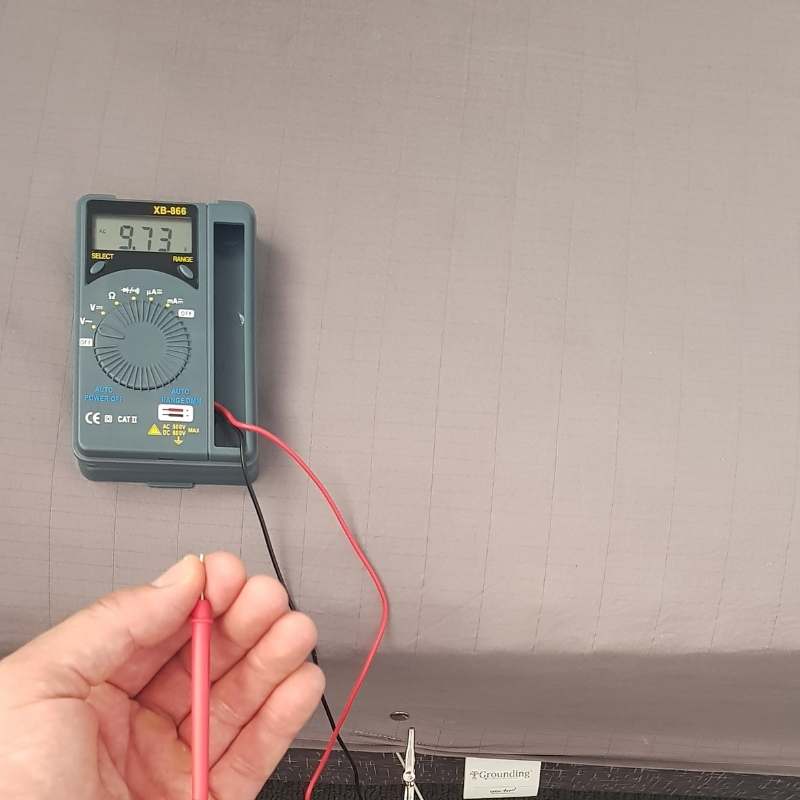
How to Use a Multimeter to Test Your Grounding Sheets and Earthing Mats
Learning how to use a multimeter might seem intimidating at first, but it’s a straightforward process once you understand the basic steps. Here is a detailed guide on how to test your grounding products for the best possible performance:
Step 1: Set Up Your Grounding Product
First, ensure that your grounding sheet or earthing mat is correctly connected. Plug the grounding cord into a well-grounded outlet and verify that the connection to your product is secure. Remember, your grounding product does not require the outlet to be switched on; the connection to the Earth is what matters, not the active flow of electrical current.
Step 2: Configure Your Multimeter
Turn on your multimeter and set it to measure AC voltage (denoted by “V~”). Many multimeters allow you to select a specific range; if available, choose a range that captures low voltages accurately (for example, a 20V AC setting). This setting is critical because you are measuring subtle voltage differences that indicate how well your product is grounding you.
Step 3: Connect the Probes
Next, attach the black (negative) probe of your multimeter to a known ground point, such as the grounding pin on your outlet or a dedicated grounding clip on your product. Then, take the red (positive) probe and hold it with your spare hand. For the most accurate measurement, consider lying down on the product while holding the red probe. This approach ensures that you capture the voltage difference between your body and the Earth accurately.
Step 4: Read and Interpret the Results
Once the probes are connected, check the multimeter’s display. A properly functioning grounding sheet or earthing mat should show a voltage reading that is very low—ideally below 0.5 volts. This low voltage indicates that your body is nearly at the same electrical potential as the Earth, meaning the grounding process is effective. While a perfect zero isn’t expected (due to the natural electrical activity of the human body), consistently low readings are a positive sign that your grounding product is performing as it should.
Step 5: Regular Testing for Consistency
For optimal long-term results, it’s advisable to test your grounding sheets and earthing mats on a regular basis. Regular testing helps you monitor the performance of your products over time and quickly identify any issues that may arise. By maintaining consistent testing conditions—such as performing the test in the same room and under similar environmental conditions—you can accurately track changes and ensure that your earthing practice remains effective. Click here to view a more detailed guide.

Addressing Common Testing Challenges
Even with the precision of a multimeter, you might encounter some common challenges when testing your grounding products. Here are a few issues and some practical tips on how to address them:
High Voltage Readings
If your multimeter shows a higher-than-expected voltage after connecting to your grounding sheet or earthing mat, it might indicate a problem with the grounding connection. Start by verifying that the outlet is properly grounded and that the grounding cord is undamaged. It may also be useful to test another outlet to rule out any issues with your home’s electrical system. Consistently high voltage readings could mean that the product’s connection is compromised and may require repair or replacement.
Inconsistent or Fluctuating Readings
Fluctuations in voltage readings can occur due to environmental factors like the presence of nearby electronic devices. To minimize these variations, try to conduct your tests under controlled and consistent conditions. If fluctuations persist, consider isolating your testing area from potential sources of interference.
Minimal Voltage Change
If connecting to your earthing mat or grounding sheet does not result in a significant drop in voltage, recheck your multimeter settings. Make sure it is set to measure AC voltage and that the probes are securely connected. If the issue remains, inspect the product itself for any signs of wear or damage that could be affecting its conductive properties. A minimal voltage change might indicate that the product is not functioning optimally, and you may need to consider troubleshooting further or seeking additional support.

Long-Term Benefits of Detailed Voltage Monitoring
Regularly using a multimeter to test your grounding sheets and earthing mats offers long-term benefits that extend beyond immediate performance verification. Detailed voltage monitoring allows you to track the gradual performance of your products over time, giving you insight into any degradation that may occur. This proactive approach not only ensures that you continue to enjoy the full range of wellness benefits—such as improved sleep, reduced stress, and lower inflammation—but also helps you make informed decisions about product maintenance or replacement.
Moreover, understanding the detailed performance of your grounding products can help you optimize your overall earthing practice. For instance, if you notice that certain environmental conditions consistently affect your voltage readings, you can adjust the placement of your grounding sheet or earthing mat to achieve a more stable connection. In this way, detailed voltage measurements empower you to refine your setup and maximize the natural benefits of earthing.
Final Thoughts
When it comes to ensuring that your grounding sheets and earthing mats are working as intended, a multimeter is an indispensable tool. While simple continuity testers can confirm that a circuit exists, they fall short of providing the detailed information required to verify a proper grounding connection. A multimeter offers precise voltage readings that allow you to assess, troubleshoot, and monitor your grounding sheet and earthing mats over time.
Related Blogs You Might Like
👉 How to Test Your Body Voltage with Earthing
👉 How Grounding Sheets & Mats Work